Changes to the Journal Page of 12 Waiheru
2026-04-25

| Journal Title | : | 12 Waiheru |
| Initials | : | Waiheru |
| Frequency | : | Twice a year |
| Online ISSN | : | 2808-4098 |
| Print ISSN | : | 2477-135X |
| Editor in Chief | : | Arsyil Waritsman |
| DOI | : | 10.70872 |
| Publisher | : | Balai Diklat Keagamaan Ambon |
12 Waiheru is a peer-reviewed academic journal published by the Balai Diklat Keagamaan Ambon, appearing twice a year in June and December. The journal serves as an open and dynamic space for scholars, practitioners, and educators from across the world to share original research and critical reflections on education, training, and religious life in contemporary societies.
The name Waiheru carries a meaningful story rooted in local wisdom from Maluku. Derived from the words “wai” (water) and “heru” (turbid or cloudy), Waiheru refers to “cloudy water,” a term historically associated with the abundant sageru (palm sap) produced in the area from enau trees. This naturally cloudy liquid reflects a deeper philosophical meaning: knowledge, much like turbid water, is not always immediately clear. It requires processes of inquiry, reflection, and interpretation to become meaningful and transformative. Inspired by this idea, 12 Waiheru embraces complexity, diversity of thought, and the ongoing process of learning as essential elements of scholarly work.
Rather than limiting itself to a single disciplinary lens, the journal welcomes interdisciplinary perspectives that connect education, training, and religious studies with broader social realities. It seeks to contribute to discussions on pedagogy, human resource development, religious education, community empowerment, and the evolving role of institutions in shaping knowledge and values in a rapidly changing world. Particular attention is given to contexts often underrepresented in global scholarship, including island societies, peripheral regions, and communities in the Global South, while maintaining relevance to international academic conversations.
12 Waiheru is committed to fostering high-quality scholarship through a rigorous double-blind peer review process and adherence to international standards of publication ethics. As an open access journal, it ensures that all published works are freely available, supporting the wider circulation of knowledge and encouraging dialogue across geographical and disciplinary boundaries.
By bringing together local wisdom and global perspectives, 12 Waiheru positions itself as a platform where ideas are not only shared but also critically engaged, refined, and transformed—contributing to the advancement of education, training practices, and religious understanding in meaningful and impactful ways.
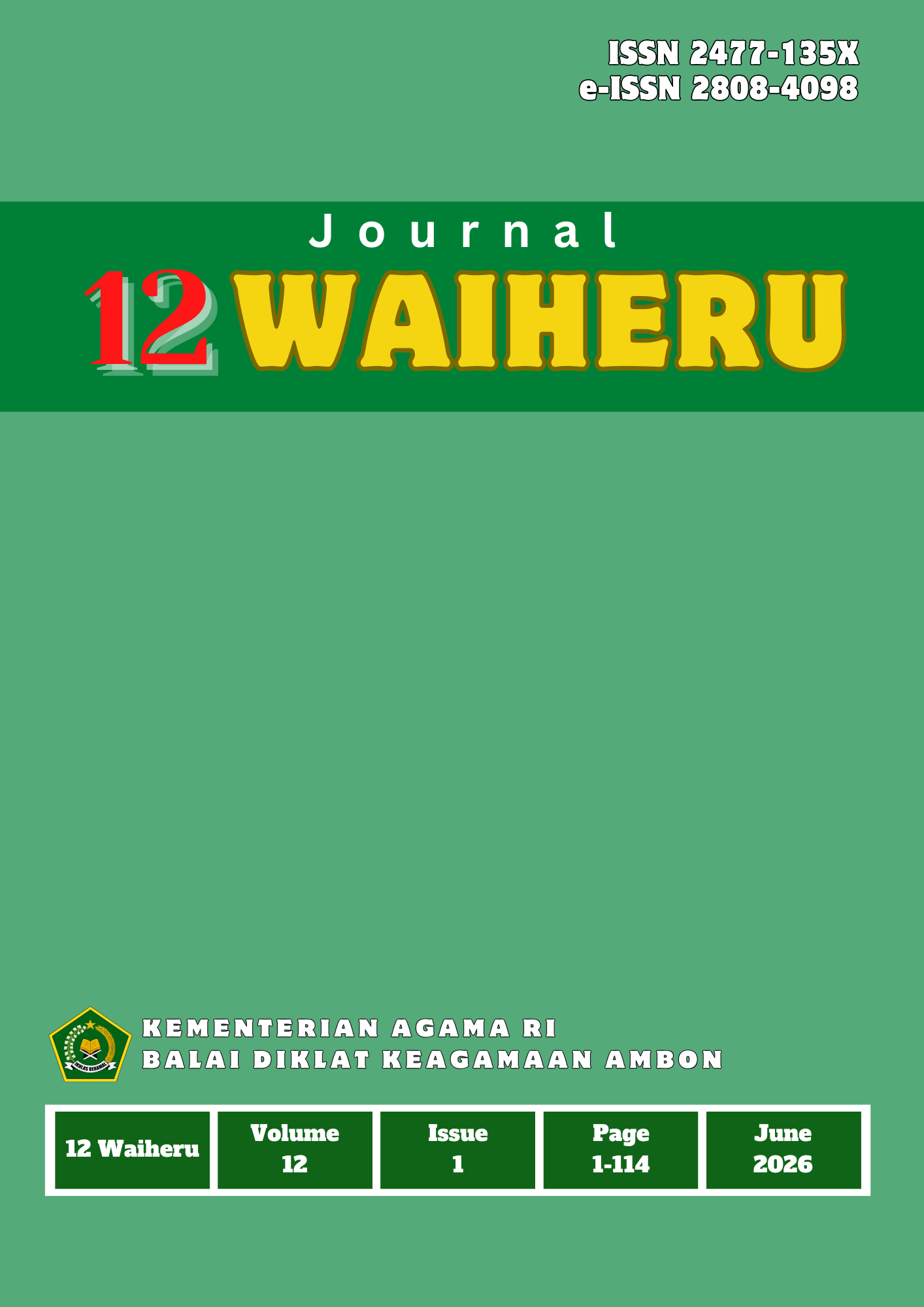
This issue of the journal features contributions from authors representing three Southeast Asian countries: Indonesia, Malaysia, and Brunei Darussalam. The diversity of the authors’ national backgrounds reflects the strength of regional academic collaboration in addressing contemporary educational, social, and religious challenges. Most articles focus on issues related to Islamic education and the development of educational human resources, including the integration of ecotheology into contextual learning, academic supervision by school principals, evaluation of multimedia training programs for Islamic school teachers, technology-based classroom management, and the development of Arabic language environments grounded in local wisdom. In addition, several studies examine the application of artificial intelligence in English for Specific Purposes (ESP) instruction, bibliometric analysis-based training for prospective school principals, and the actualization of the values of Pancasila and the 1945 Constitution of the Republic of Indonesia in basic training programs for prospective civil servants. Beyond educational themes, this issue also highlights a range of social, cultural, environmental, and literacy-related issues that are highly relevant to contemporary society. The article on the synergy between culture and religion in gender-responsive education within the Hukurila indigenous community in Maluku enriches perspectives on local wisdom-based and inclusive educational practices. The study on collective responses to the student reading crisis in cyberspace explores the dynamics of social narratives emerging within digital society. Meanwhile, environmental sustainability receives significant attention through discussions of ecotheology and the integration of eco-Sufism into the hidden curriculum of Islamic boarding schools to foster environmentally conscious religious character. Overall, this collection of articles reflects a growing research orientation toward educational transformation, strengthening cultural and religious values, the use of digital technologies, and the development of character and environmental awareness in modern society.
Indexing




Contact Information
Email:
jurnal12waiherubdkambon@gmail.com
Address:
Laksdya Leo Wattimena Street, Nania 97232, Baguala, Ambon, Maluku Province, Indonesia
This work is licensed under CC BY-NC-SA 4.0